Why Track Your Imposter Stats?

In the world of social deduction games, knowledge is power. While many players rely on gut instinct, the best detectives and master manipulators rely on data. By tracking your Imposter Game history, you can uncover patterns in your gameplay that you never noticed before.

Are you a "Civilian Specialist" who can spot a lie from a mile away but crumbles under pressure when playing as the Imposter? Or are you a "Chaos Agent" who thrives on deception but fails to contribute to village consensus? Our local tracking dashboard helps you answer these questions without requiring any login or cloud data transfer.

Regularly reviewing your match history allows you to refine your strategy. For instance, if you notice your Imposter win-rate is dipping below 20%, it might mean you are getting too defensive when accused. Conversely, if your Civilian win-rate is low, perhaps you are too trusting or easily swayed by others' confident assertions.


Civilian vs Imposter Mindset Comparison - Deduction vs Deception

Advanced Data-Driven Strategies

Improving your win rate isn't just about luck; it's about understanding the probability and psychology of the game. Here are some advanced concepts derived from analyzing thousands of game outcomes:

1. The "Early Voter" Bias

Data shows that players who cast the first vote often control the narrative of the round. However, being too eager can backfire. If you vote instantly without discussion, seasoned players might flag you as an Imposter trying to rush a kill. A balanced player waits for the "discussion peak" before striking.

Voting Impact Heatmap - Optimal Voting Timing Analysis

Voting Impact Analysis

2. Word Association Depth

Beginners use first-level associations (e.g., word: "Apple", clue: "Fruit"). Pros use second-level associations (e.g., clue: "Gravity" or "Doctor"). Tracking your wins can encourage you to experiment with deeper clues. If you find yourself getting caught often, try moving one level deeper in your abstractions.

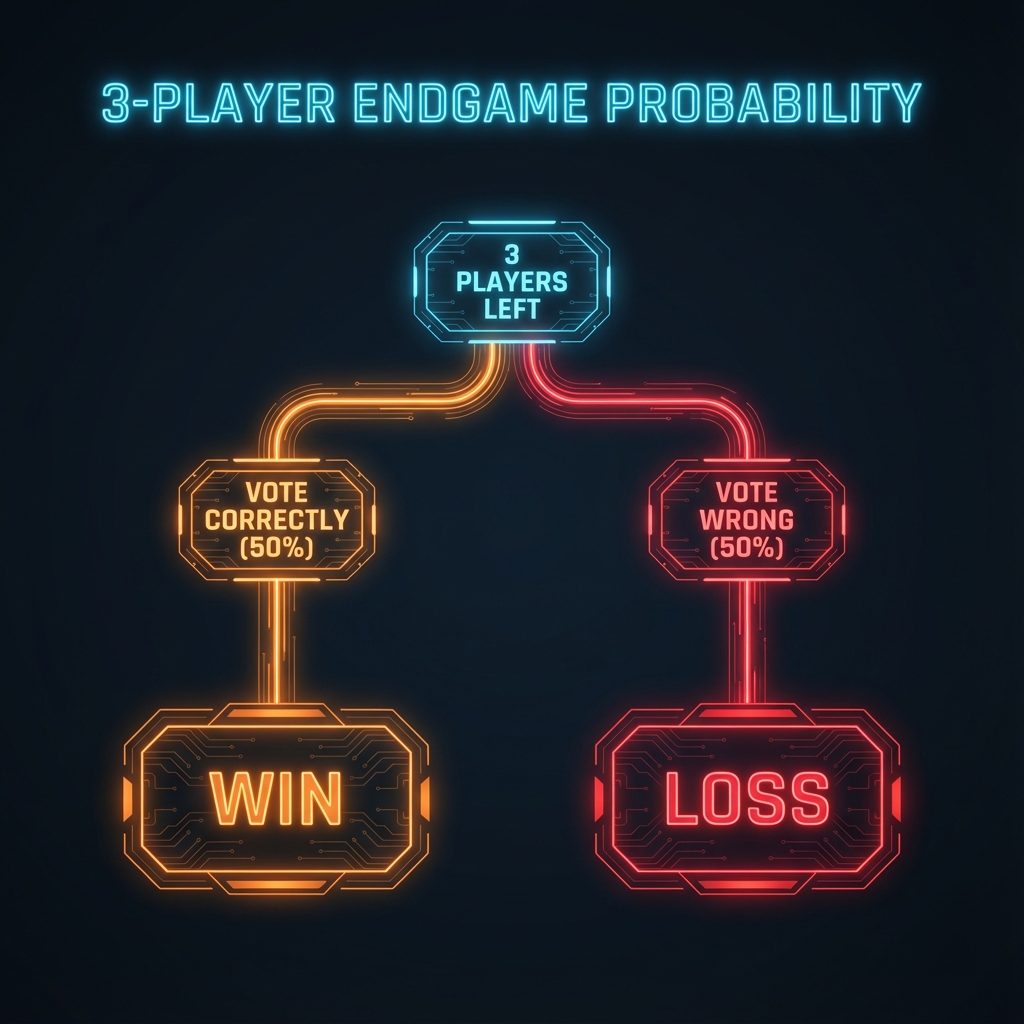
3. The 3-Player Endgame

Many games end in a 3-player scenario: 2 Civilians vs 1 Imposter. This is the statistically hardest moment for Civilians, as the random chance of voting correctly is 50/50, but the social pressure is 100%. Reviewing your history for "Final Round Losses" can indicate if you struggle with high-pressure tie-breakers.

3-Player Endgame Decision Tree - Win Probability Chart

Pro Tip: Variance Management

Don't be discouraged by a losing streak. In a 7-player game, an Imposter is expected to lose ~70% of the time. If you win even 40% of your Imposter games, you are performing significantly above average!

Visualizing Your Deception Skills

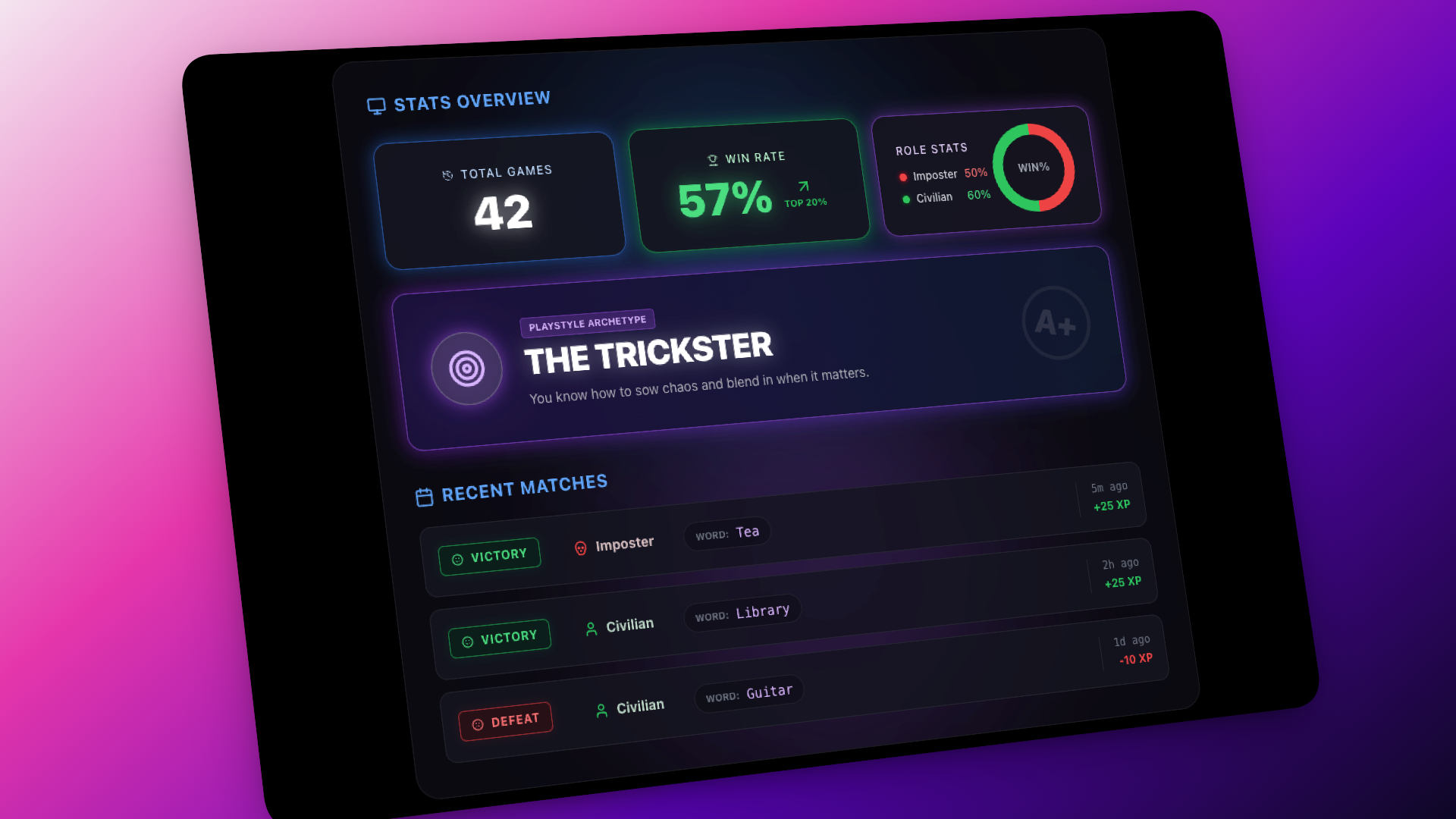
The dashboard provides a comprehensive breakdown of your performance across both roles. Here is what you can expect to see as you play more games:

Imposter Game Stats Dashboard - Main Interface Preview
Live Preview

Win Rate Analysis

See exactly how often you win as a Civilian versus an Imposter. A balanced player should aim for >50% on both, but Imposter wins are notoriously harder to secure.

Role Performance

Track which words you struggle with. Do you lose more often with abstract concepts like "Love" or "Idea"? Or are concrete objects easier to lie about? This granular data acts as a mirror to your own cognitive biases.

The Psychology of Game Stats

Your statistics are more than just numbers; they are a mirror of your social psychology. In Imposter Game, high-level play requires adapting your personality to the situation.

The "Imposter Ratio"

Consider the Imposter Ratio. In a typical 6-player game, an Imposter has a 16% chance of being selected but faces 5 opponents. Statistically, a 30% win rate is "average" for an Imposter. If your win rate is above 45%, you are statistically a statistical anomaly—or a lying prodigy. This ratio helps you set realistic expectations: as an Imposter, survival is the goal, but victory is a luxury.

Imposter Win Rate Benchmark - Average vs Pro Stats

Identifying Your Archetype

Based on your data, our system assigns you a hidden "Playstyle Archetype". Are you The Detective that never misses a clue? Or The Wildcard whose voting pattern is so erratic that even fellow civilians get suspicious? Analyzing these trends helps you adjust. If you are too aggressive as a civilian, you might get voted out by mistake. If you are too quiet as an imposter, you become an easy target for elimination. Understanding your own meta-game is the first step to mastering the art of social deduction.

Player Archetype Radar Chart - Stats Visualization

Frequently Asked Questions

Where is my data stored?

Your game history is stored 100% locally on your device using your browser's LocalStorage. We prioritize your privacy and do not track, upload, or sell your personal gameplay data to our servers.

Note: If you clear your browser cache or switch to 'Incognito Mode', your history will not be visible.

Does clearing history affect game ranking?

Currently, Imposter Game does not have a global leaderboard or persistent server-side ranking called "ELO". Clearing your history only resets your personal local view. It will not affect your standing in any active game rooms.

Can I transfer my stats to another phone?

Since data is currently local-only, it does not automatically sync between devices (e.g., from your phone to your laptop).

Coming Soon: We are working on an optional Cloud Account feature (v1.4) that will allow you to save and sync progress across devices!

How are playstyle archetypes calculated?

Archetypes are derived from the ratio of your wins between roles and your total play count. For example, winning >60% of games as an Imposter grants the "Mastermind" title, whereas a balanced win rate across many games grants "The Veteran".

Ready to Improve Your Stats?

The best way to get better data is to play more games. Need fresh word pairs? Use our word generator to create custom game setups.